
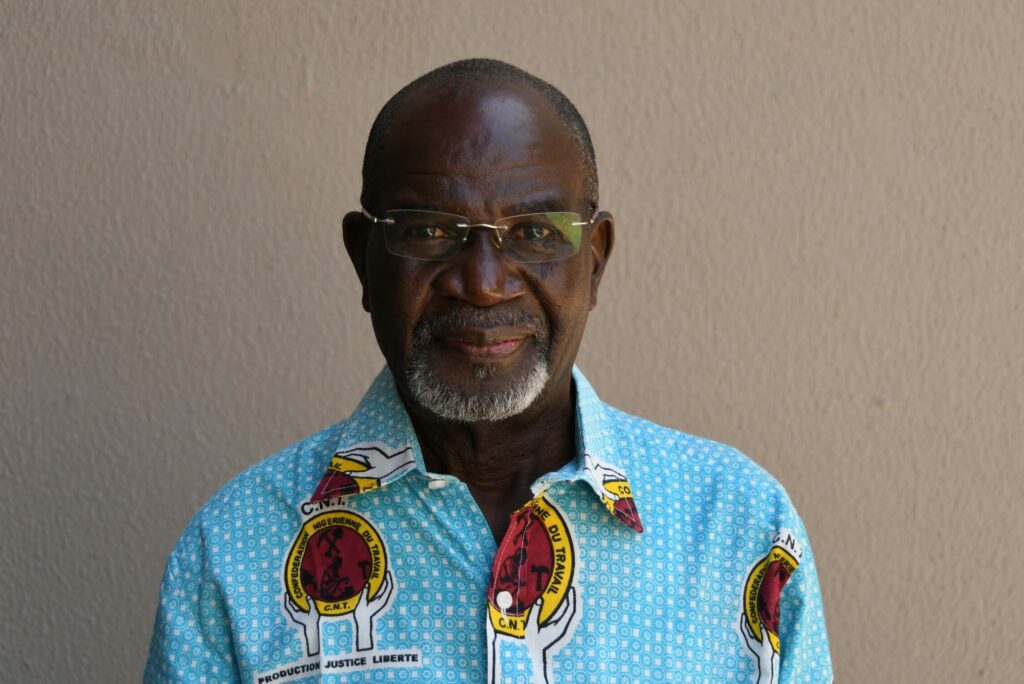
On 07 November the sad news came to us that that our dear colleague and friend Koffi Chrysanthe Zounnadjala Agbogbe passed away on 28 October. He was 79 years old.
Koffi Chrysanthe Zounnadjala Agbogbe was a true trade unionist working in extremely difficult conditions. The first encounter with Koffi was at the 27th World Congress of the World Federation of Clerical Workers – WFCW (the predecessor of the World Organization of Workers – WOW) in Chile in 1992. Koffi was the only delegate from Africa.
In those days the WFCW was not present in Africa. Koffi had ended up at the conference through the then African training centre FOPADESC (Fondation Panafricaine pour le Développement Social et Communautaire). Through conversations with Piet Nelissen, former Executive Secretary of the WFCW and member of the board of WOW, it became clear that Koffi was interested in setting up an African regional organization. That is if support for his idea was existing.
As a newly appointed Executive Secretary of the WFCW, Piet Nelissen promised Koffi his full support and agreed to travel to Africa when this new regional organization was officially established.
With the support of Jaap Kos, then President of the CNV Services Union (CNV Dienstenbond), and Austrian Board Members Ivo Psenner and Richard Paiha of the Austrian Services Union FCG/GPA the first steps were taken.
Koffi immediately started to work on the creation of a regional organization. From Nebyu Shone, the then coordinator for CNV development cooperation in Togo, Piet Nelissen received positive report about Koffi’s activities. This was very comforting.
In preparation for the 28th WFCW World Congress, Roel Rotshuizen, who had since become a candidate for the position of President as successor of Jaap Kos, and Piet Nelissen travelled to Togo, Benin and Ghana. The mission was supported by Koffi and Nebeyu Shone. At this 28th WCWF World Congress, which took place in Feldkirch, Austria, in 1996, two other delegates from Africa were present alongside Koffi. WFCW President Jaap Kos was formally succeeded by Roel Rotshuizen, General Secretary of the CNV Dienstenbond.
In 1997, with the help of the CNV (Nebeyu Shone) and the WFCW, Koffi organised a seminar, after which the Pan-African Federation of Civil Servants FPE (Fédération Panafricaine des Employés) was founded with eight unions from different African countries. A number of WFCW Board Members were present. Since then, Koffi became a Member of the WFCW World Board (later the WOW World Board).
The establishment of the FPE marked a turning point in the WFCW’s relations with Africa. The capital Lomé in Togo had already been the centre of the African organizations already member of the former World Confederation of Labour – WCL. It served as the seat of all African national confederations. Thereafter it also became the centre of the African trade union organization FPE. Koffi became the central figure of the FPE and as such he coordinated and organized everything connected to the FPE.
As a result, in November 2000, for the first time in the history of the WFCW, a World Congress was held in Africa, at the FOPADESC training centre in Togo. Under Koffi’s inspiring leadership, the FPE organised several more seminars in Africa.
‘Over the years, I have come to known Koffi as a reliable trade union leader who, with his dedication and knowledge, took on the difficult and demanding task of further expanding the FPE across the immense continent of Africa. It was never about Koffi, but always about improving the position of workers’, Piet Nelissen recollected.
Roel Rotshuizen well remembered that in those early days communication was not easy. ‘Documents were still exchanged by letter. A letter from Brussels to Koffi’s office took almost a month to arrive. If you were lucky, you would receive a prompt reply. That is a month later’, he said. ‘Koffi liked to arrange as much as possible over the telephone. From the moment mobile phones became available, it was considerably easier to communicate with him’, he continued.
Language remained a challenge. Koffi only spoke Ewe and French. This, however, did not prevent him to talk to people who did not have any knowledge of the French language. With his charm, positive attitude, openness, and extreme friendliness he managed everywhere. Everyone respected and liked Koffi.
Koffi was a typical “people person”. He enjoyed seeing you and preferred to take you everywhere with him in Togo. Koffi knew everyone in Lomé and, in fact, everyone in the world of the African trade union movement. He also liked to introduce you to everyone. If you were eating somewhere in Lomé and he saw someone he knew, preferably a local or national politician, he would insist on taking you along to be introduced. He enjoyed having foreign guests visit.
You could also see how many people he knew in the trade union movement in Africa when attending the annual ILO Conference in Geneva, Switzerland. You would walk through the corridors of that enormous office complex, and he knew every African you came across. And they all knew Koffi!
‘In my opinion, his greatest triumph as a trade union leader was when he managed to conclude a collective labour agreement in the commercial sector for the whole of Togo with the employers’ umbrella organisation, Roel Rotshuizen stated. ‘It was a long-term agreement that would gradually increase the wages of the employees in general, and his members in particular and also ensure that the employers made a long-term financial contribution to his national trade union, the National Federation of Employees and Technicians of Togo – FENET (Fédération Nationale des Employés et Techniciens du Togo)’.
We will all miss Koffi! His warmth, his friendship, his humour and his knowledge of Africa! Koffi was a deeply religious man. We wish him the peace and security of his Creator.